
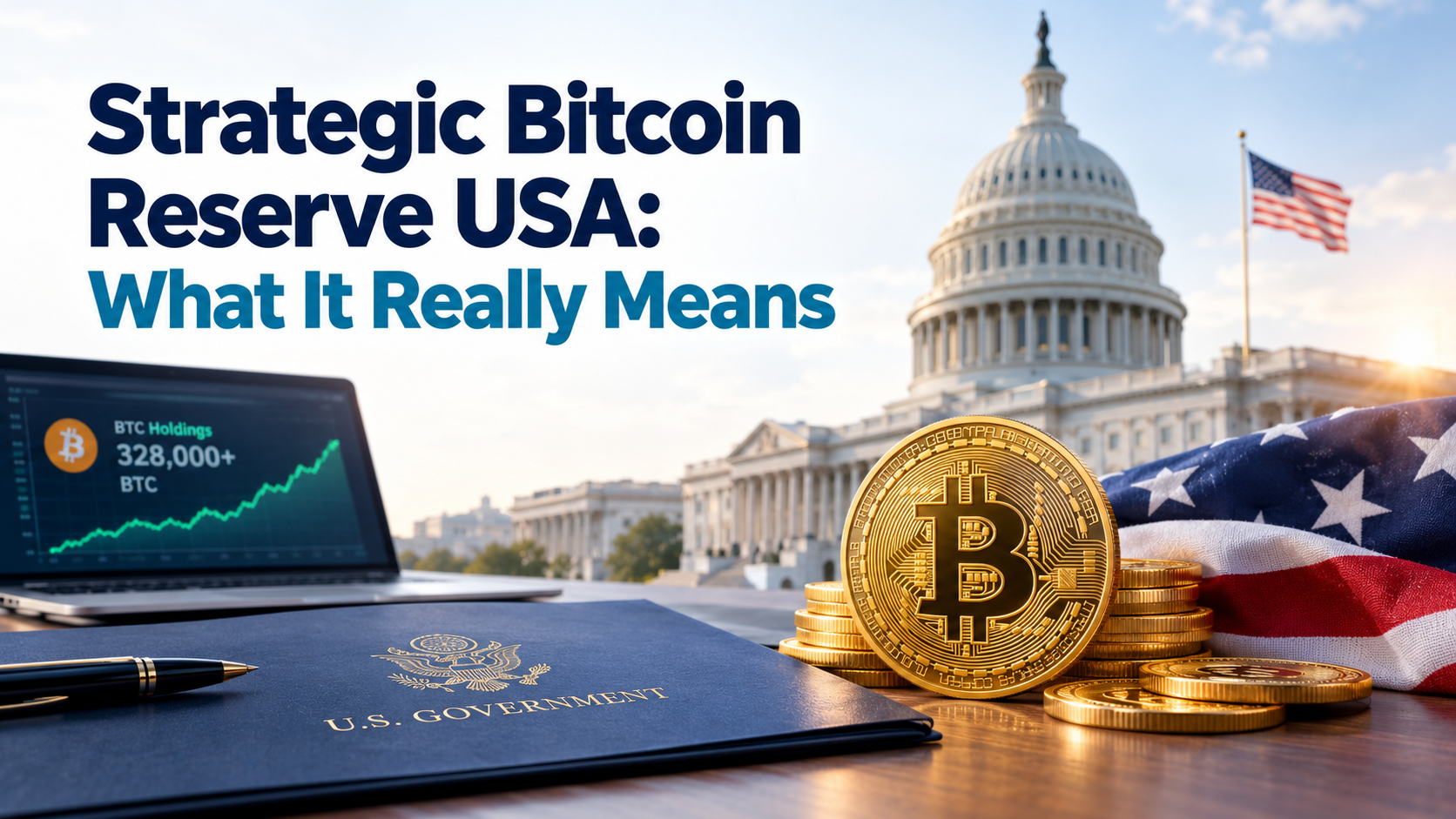
The United States government owns more bitcoin than any other country on earth. Not because it bought any. Because it caught criminals, took their coins, and never sold them. That’s the short version of the strategic Bitcoin Reserve USA story. A long story consists of an executive order, a stymied Senate bill, twelve states competing to implement a similar concept, and a genuine discussion about how much of all of that is actually beneficial for the nation. Here is the reality at the moment, stated clearly. What Is the Strategic Bitcoin Reserve? On March 6, 2025, President Trump enacted Executive Order 14233, which included both creation of the Strategic Bitcoin Reserve and establishment of the US Digital Asset Stockpile. They are easily confused, so keeping them apart is useful. The Reserve holds bitcoin only. About 198,000 BTC went in at the start, all of it seized from criminals through forfeiture cases. The order says none of that bitcoin can be sold. It just sits there, the same way the country holds gold. The stockpile is different. It holds other seized crypto, things like Ethereum, XRP, Solana, and Cardano. The Treasury has more freedom to manage or sell those assets. Only the bitcoin side has that strict “do not sell” rule. Neither pool was built with tax dollars. Every dollar that was seized on those accounts was through the process of criminal and civil forfeiture. The forfeitures included seizures made in drug cases, fraud cases, and arrests in the dark web. How Much Bitcoin Does the US Government Actually Own? The strategic bitcoin reserve USA holds is larger than most people realize once you count every federal agency, not just the Reserve itself. Counting everything held across federal agencies, the U.S. government’s bitcoin position sits above 328,000 BTC as of early 2026. That includes coins held by the Justice Department, the IRS Criminal Investigation unit, and the US Marshals Service, who’ve been collecting seized bitcoin piece by piece for years. Nobody has ever done a full, clean audit of these holdings. That’s part of what the executive order tried to fix. It told agencies to account for every coin they’re sitting on, because for years the numbers were scattered and nobody had the full picture. There’s a real cost to guessing wrong here, too. Past administrations sold seized bitcoin early, back when prices were far lower. Officials have pointed to over $17 billion in value the government gave up by cashing out too soon. That history is a big reason the new order bans future sales outright. The BITCOIN Act: What the Senate Bill Would Actually Change An executive order is not legislation; it can be overturned by any future president with a simple signature. Trump did this, too.That’s exactly why Senator Cynthia Lummis and Representative Nick Begich introduced the BITCOIN Act, a bill meant to turn the policy into something permanent. The bill would go further than the executive order in a few specific ways: The Treasury would be authorized to buy up to 1 million BTC over five years, capped at 200,000 BTC per year. That’s roughly 5% of all the bitcoin that will ever exist. Funding would come from existing Federal Reserve remittances and a revaluation of old gold certificates, not new taxes or federal borrowing. Any bitcoin placed in the reserve would be locked up for a minimum of 20 years, by law, with narrow exceptions tied to paying down debt. The bill also protects the right of ordinary Americans to hold their own bitcoin in a private wallet without government interference, a provision that has nothing to do with the reserve itself but matters to a lot of bitcoin holders. As of early 2026, the bill still sits with the Senate Banking Committee; no floor vote is scheduled. And here’s the odd part: Treasury Secretary Scott Bessent has said outright that the government “won’t be buying” more bitcoin right now, even though the executive order already lets it, as long as the purchases are budget-neutral. So the authority is there. Nobody’s using it. States Are Building Their Own Bitcoin Reserves Too This isn’t only a federal story. New Hampshire became the first state to pass its own bitcoin reserve law, back in May 2025. Texas followed with a similar law, run through its Comptroller of Public Accounts, that only allows purchases of cryptocurrencies with a market cap above $500 billion over the past two years, a bar only bitcoin currently clears. More than a dozen other states have introduced comparable bills. Most follow the same basic shape: let the state treasury hold a small allocation of bitcoin as a hedge, similar to how a state might hold gold or foreign currency reserves. None of these state efforts require federal approval, and they move at very different speeds depending on the state legislature. If you want to track how individual states and federal proposals compare, our team keeps an updated breakdown on the strategic bitcoin reserve USA policy landscape at USA Crypto Trends, covering each state bill as it moves. The Case For and Against a Bitcoin Reserve The argument for it is pretty simple. The US already owns hundreds of thousands of bitcoin from forfeiture cases; selling it early has already cost billions in missed value, and holding it the way the country holds gold protects against repeating that mistake while other countries start building their own positions. The argument against it is messier. Bitcoin can lose a third of its value in a matter of weeks, so calling it a reserve asset like gold doesn’t quite hold up once prices actually move. Custody is a real problem too. Government bitcoin wallets have already been targeted, and reports from early 2026 pointed to a breach of Marshals Service holdings, with loss estimates anywhere from $25 million to over $60 million depending on who’s reporting it. Securing this much bitcoin is harder than the policy papers make it sound. And underneath all of it sits a

Best Crypto Exchange for US Investors: What Actually Matters
A coworker of mine picked an exchange because his cousin liked it at a barbecue. Two summers ago. He never checked the fees. He never checked if it was even legal in his state.Then he tried to pull his money out. The exchange took almost 4% just for a withdrawal. He still uses it. Mostly because he’s stubborn now. That’s how many people end up on the wrong exchange. They don’t pick the best crypto exchange for US investors on purpose. They just don’t pick at all. Someone else picks for them.Quick note before we go further: I’m not a financial advisor. This isn’t advice. It’s just a look at what these platforms really offer, so you can decide what matters to you. What Actually Matters When You Pick a Crypto Exchange Check the rules first. In the US, that means the exchange should be registered with FinCEN. It should also obey the rules in your state. Some big names, like Binance’s international site, KuCoin, and Bybit, either have left the US or work under heavy limits here. That’s not a small detail. If you want the full picture on the situation, our guide to crypto regulation in the US breaks it down state by state. Fees add up fast. Some exchanges charge a flat fee per trade. Others hide the cost in the price itself, called the spread. That means you might pay more than you think and never see it on a receipt. Insurance is the part people skip. Crypto on any exchange, even a fully legal US one, is not backed by the FDIC. That’s a real gap. Money in a savings account has a safety net. Crypto does not. Best Crypto Exchange for Beginners: Coinbase Coinbase is the name most people already know. There’s a reason for that. It’s a public US company. It follows FinCEN rules. Almost 100 million people use it.The app is easy. That matters a lot if you’ve never bought crypto and don’t want to feel lost. It offers around 250 coins, though your state may limit which ones you can buy. New to this? Our how-to-buy-your-first-crypto walkthrough covers the basics before you sign up anywhere. Coinbase’s standard fees run higher than some competitors, especially on smaller trades, so if you’re trading often, the cost adds up faster here than elsewhere. Best Crypto Exchange for Security-Focused Investors: Kraken and Gemini If safety is your main worry, Kraken and Gemini both take it seriously. Kraken has been around a long time. It shows proof that it holds the coins it says it does. ISomething breaks at 2 a.m., and there’s actually someone to ask. That’s not nothing. Gemini’s licensed by New York’s financial regulators not every platform in this space can say that. It holds two strict security certificates that outside auditors checked by hand. It works in all 50 states and insures part of your funds. Its simple mode costs more than its advanced trading mode, though. And New York residents can’t trade a few coins, like USDT, due to state rules. Best for Stocks Plus Crypto: Robinhood Robinhood built its name on free stock trades. Crypto came later, and it still feels like an extra feature, not the main product. That’s not a bad thing. If you want stocks, ETFs, and crypto in one app, this covers it.The SEC and FINRA regulate Robinhood. It offers over 35 coins. It doesn’t charge a set trading fee, though the spread still applies, like everywhere else. The catch is depth. Serious traders will run out of room fast. There’s no way to trade crypto futures, and staking works for only a couple of coins.Want the fees and coin counts side by side instead of spread across this page? Check our full best crypto exchange comparison table. Common Mistakes People Make Choosing a Crypto Exchange Picking the flashiest app instead of checking if it’s even legal where you live. Looks matter less than the license.Thinking all fees are equal. They’re not. An app with “no fee” can still cost more through the spread than one with a plain, upfront charge.Believing crypto is FDIC-insured because the exchange banks with an FDIC-insured bank is a misconception. The FDIC has warned about this exact mix-up. A bank partnership does not cover the crypto itself. Signing up through whatever referral link an exchange pushes that week, instead of comparing two or three first. It takes fifteen extra minutes and saves a lot of regret later. Our crypto safety checklist is a fast way to run through this before you commit. Coinbase vs. Kraken vs. Gemini: The Short Version Coinbase wins on ease.Good starting point if you’re new. But if you’re trading often, Kraken’s worth a look in deeper order books, and it’s been around long enough to have weathered a few crashes. Gemini wins on rules and state licenses, if that’s your top concern. None of them is the single best crypto exchange for US investors. Honestly it depends what you’re optimizing for. Simplicity, depth, or not lying awake wondering if your money’s safe pick one, because you’re not getting all three from the same platform. Frequently Asked Questions What is the safest crypto exchange for US investors? Gemini and Kraken both have strong safety records and outside security checks. But safety also depends on you. Turn on two-factor login. Don’t leave large amounts sitting on any exchange for too long. Is Coinbase good for beginners? Yes, in most cases. It’s simple to use, and it’s a US public company with a solid track record. The tradeoff is higher fees on small trades compared to some rivals. Are crypto exchanges FDIC insured? No. Crypto held on any exchange isn’t covered by the FDIC, even if the exchange banks with an FDIC-insured bank. Only actual cash in that bank partnership might be covered. Not the crypto. Can I use Binance in the US? Not the global version. Binance. US is a separate, smaller platform for US residents since the

Crypto ETF Approval News: Here’s What’s Happening Right Now
In case you have been observing the crypto world recently, you will discover that the term “ETF” has come up multiple times. ETF is simply an abbreviation for an exchange-traded fund. It’s a way to invest in coins such as Bitcoin or Ethereum without having to own them.. You just buy shares through a regular stock account, the same one you’d use for anything else. (Not sure how ETFs work under the hood? Our beginner’s guide to ETFs walks through the basics.) Right now, the crypto ETF approval news is moving fast. The government agency in charge of approving these funds, called the SEC, is working through hundreds of new applications. Some rules have gotten faster and easier. Others are getting more careful review. We’ll walk through what’s actually going on in plain language no finance degree required. Why This Crypto ETF Approval News Actually Matters Here’s the practical part. Once a crypto ETF gets the green light, regular investors can buy into that coin without opening a crypto wallet or signing up for an exchange. You just buy shares the same way you’d buy Apple or Amazon stock. This also brings in bigger investors, like pension funds and large banks. Many of these big players are not allowed to hold crypto directly. But once there’s a regulated ETF, the door opens for them too. That’s why every new approval or delay tends to move crypto prices and grab headlines. The Rules Got Faster in 2026 Back in September 2025, the SEC approved new “generic listing standards” for crypto ETFs. In plain English, this means many crypto ETFs no longer have to go through the SEC’s longest and slowest approval process. Before, a fund could wait up to 240 days for a decision. Now, many funds can get approved in as little as 75 days. That one change had a big ripple effect. Some analysts think we could see well over 100 new crypto ETFs hit the U.S. market this year alone. Bloomberg Intelligence’s James Seyffart has noted that more than 100 crypto ETF filings are still parked at the SEC, waiting their turn. The SEC also approved a multi-asset fund from Grayscale that bundles several coins together—Bitcoin, Ethereum, Solana, Cardano, and XRP all in one basket. That’s worth pausing on. It suggests the SEC is getting comfortable with funds that go beyond the usual Bitcoin and Ethereum ETFs and start mixing in smaller coins too. A Legal Boost: Assets Get Labeled as Commodities Here’s one of the biggest sticking points for altcoin ETFs (that’s ETFs for coins other than Bitcoin and Ethereum): is the coin a security or a commodity? Congress is trying to make that classification permanent with a bill called the CLARITY Act. If it passes, it would lock the commodity status into federal law, so a future SEC couldn’t quietly reverse it. Right now the bill has cleared a few committee votes but still needs more support to actually pass. Betting markets put its odds of passing sometime in 2026 above 50%, though nobody’s sure exactly when. Where the SEC Is Hitting the Brakes Not everything is moving quickly, though. Over the past few weeks, the SEC has clearly slowed down on some of the newer, more complicated products. On June 30, 2026, the agency opened a formal 60-day public comment period on what it’s calling “novel ETFs,” its term for funds built around newer or riskier ideas, such as: In other words, the SEC wants to make sure that it has the ability to safely manage these newer, more complex products with its existing rulebook. That review has already paused around two dozen event-contract and prediction-market filings while regulators work through questions about pricing, settlement, and disclosure. The agency is also considering letting some companies file their ETF paperwork confidentially at first, so new fund ideas aren’t copied by competitors before launch. And with roughly 200 ETF filings landing on its desk every month now, it’s obvious the SEC is trying to build a more organized system just to keep up. What This Means If You’re Keeping an Eye on Crypto ETFs Here’s a simple way to think about where things stand: Moving fast: Simple, single-asset spot ETFs for coins already classified as commodities. These get the benefit of that shorter 75-day review window. Moving carefully: More complex products, staking ETFs, leveraged funds, and prediction-market ETFs are under fresh scrutiny while the SEC figures out new rules. Up for debate: Proposed laws such as the CLARITY Act, which would establish legal protections for crypto assets but has yet to pass Congress. Investors should keep an eye on this combination of speed and caution.A wave of new approvals could bring more coins within easy reach through a normal brokerage account. At the same time, that extra scrutiny is a good reminder — not every new fund idea is going to sail through quickly, and some might not make it to market at all. What to Watch Next A few key dates and events could shape the next round of crypto ETF approval news: The Bottom Line Crypto ETFs news have come a long way in a short time. Faster rules, clearer asset classifications, and more issuer confidence have opened the door to a much bigger wave of approvals than we’ve seen before. At the same time, the SEC is being more careful with newer, riskier fund designs, which means some products will take longer to reach investors. The best way to stay ahead is to keep an eye on the big milestones: the SEC’s comment period, the CLARITY Act’s progress in Congress, and any major new fund approvals. As always, this article is for general information only and isn’t financial advice — always do your own research or talk to a financial professional before investing. Stay tuned to USA Crypto Trends for ongoing coverage of crypto ETF approval news as new developments unfold. FAQ What is a crypto ETF? A crypto ETF is a way
Bitcoin vs. Ethereum: What Actually Sets Them Apart
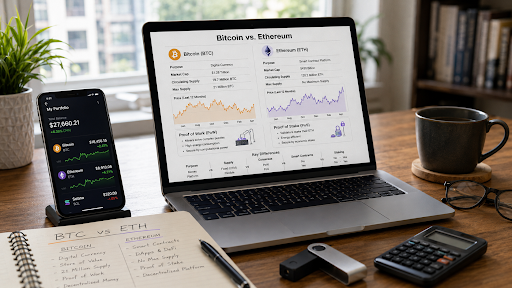
These two names are being used interchangeably by people. They do not and that’s something that fools many of the novices in the first few minutes. Bitcoin and Ethereum are types of cryptocurrencies. After that, well, they have very little in common. The Bitcoin protocol was designed to be a money protocol. Ethereum was designed to facilitate software.Think cash versus a laptop, both useful, neither doing the other’s job. Bitcoin Was Built to Do One Thing Bitcoin showed up in 2009 chasing a pretty simple idea: money nobody controls. Not a bank, not a government, nobody sitting somewhere with a switch they get to flip whenever it’s convenient for them. There will only ever be 21 million bitcoin. That’s the entire pitch, more or less. People compare it to gold for exactly that reason. No one ever decides to increase printing when demand increases. Proof-of-work is used to operate the network. Runners compete to solve puzzles, and the first one to do so rewards them with the addition of the next block of transactions to the chain. That takes real electricity. Real hardware, sitting in a warehouse somewhere, running constantly. Sounds wasteful until you realize that’s kind of the point the cost is what makes the network expensive to attack. No apps. No contracts. Bitcoin moves value and holds value. That’s the whole job. Ethereum Wanted to Be a Platform Ethereum launched in 2015, chasing something bigger. Not just moving money around running programs. Smart contracts are how it does that. Developers build straight onto Ethereum’s blockchain: lending apps, trading platforms, games, digital collectibles all of it lives there. Ether isn’t something you just sit on either. It also pays for computation on the network. There’s even a name for that fee, and it gives the whole thing away: gas. Supply works differently here too. No fixed cap like bitcoin has. Instead, it moves with how busy the network gets fees get burned, pulled out of circulation for good, so heavy traffic can actually shrink the supply instead of growing it. Weird to wrap your head around the first time you hear it, but that’s the design. Another change to be aware of, and it’s a good one: Like Bitcoin, Ethereum previously relied on proof-of-work as well. Then in 2022 it switched over to proof-of-stake. Individuals are locking up ETER rather than mining on the rigs. Energy use dropped fast after that, and stakers started earning rewards just for holding coins in the system. The Core Differences, Side by Side Purpose is the biggest split. Bitcoin holds value. Ethereum builds things on top of it. Supply behaves differently too. Bitcoin stops hard at 21 million, no exceptions. Ethereum drifts depending on usage. The security setup isn’t even close to the same. Mining rigs on one side, locked-up coins on the other. Smart contracts: They basically don’t exist on Bitcoin. Ethereum was built around them from day one. Staking. There’s also the staking piece. You can’t stake Bitcoin on its own chain, not natively. Ethereum, you can, and you get paid for the trouble. What People Actually Do With Each One Bitcoin mostly gets bought and left alone. People treat it as a way to park value outside the regular banking system or as a hedge when inflation starts worrying them. It also crosses borders without needing a bank sitting in the middle of the transaction. Ethereum works more like a foundation. Nearly all of decentralized finance runs on it, or on networks built off it. Developers keep showing up because the tools already exist and so does the community. Bitcoin’s the vault you don’t open. Ethereum’s the workshop where things actually get built. Size Matters More Than People Think Bitcoin’s market cap has stayed well ahead of Ethereum’s for most of their history. Bigger markets swing less hard, generally, and pull in more institutional money, banks, funds, and the players who like things a little more established before they get involved. Ethereum’s price sticks closer to what’s happening on its own network. More DeFi activity, more transactions, more demand for ether just to keep the machine running. Both prices move constantly, sometimes a lot in a single day. Any dollar figure sitting in an article like this one goes stale within hours. Pull up a live price tracker if you actually need current numbers. Which One Should You Learn First? Bitcoin, if you’re brand new. One idea to wrap your head around, and that’s basically it. Ethereum takes longer. Gas fees, staking, smart contracts, and a much bigger ecosystem to make sense of. More powerful, sure, but more that can go sideways if you don’t fully get what you’re doing. A lot of people end up holding both. Not because they couldn’t pick a side because the two were never really fighting for the same job in the first place. Quick note: this is an explainer, not investment advice. What you do with your money is entirely your call. It’s worth doing your own digging first, or talking to someone qualified, before putting real money into either one. More breakdowns like this one live at usacryptotrends.net. Frequently Asked Questions Is Bitcoin or Ethereum the better investment? It depends on what you’re after. They’re built for different jobs, so “better” doesn’t really apply here, and again, this isn’t financial advice. Could Ethereum eventually replace Bitcoin? Not likely, since they’re not really competing. Bitcoin’s about holding value. Ethereum’s about building on top of it. Different problems, different tools. Why does one have a fixed supply and the other doesn’t? Bitcoin was designed to act like scarce gold hard cap, no exceptions.The supply is designed to match the use of the network, instead of a fixed amount, giving Ethereum a lot of flexibility.

How to Buy Cryptocurrency in the USA: A Simple Guide for 2026
Last month, a coworker of mine put $40 into Bitcoin using nothing but her phone and her lunch break. She didn’t study charts. She didn’t know what a “wallet seed phrase” was. She just wanted to try it, the same way you might try a new bank app. That’s where most people start now.. And if you’re curious about how to buy cryptocurrency in the USA without getting caught up in jargon, you have come to the proper place. This is a guide on how to do the real steps – choosing the platform, verifying your identity, funding your account, buying your first coin, and protecting your coins. No hype. No predictions on the price trends. Just the process, simply explained. Is Cryptocurrency Legal in the US? Yes. Investing in and holding cryptocurrencies is legal throughout the USA. However, each state has its own set of rules, and that’s where things go awry. In New York, for instance, crypto companies must obtain a special license known as a BitLicense.That’s why some exchanges skip New York entirely or offer a smaller list of coins there. Hawaii used to make life hard for exchanges too, though most of those restrictions have loosened. The short version: check whether your exchange serves your state before you sign up. Most major platforms list this on their support page. Step 1: Pick a Crypto Exchange This is the biggest decision in the whole process, so slow down here..So, when people look for the best cryptocurrency exchanges in the USA, they would typically be comparing four things: fees, security, coin selection, and customer support. A few things worth checking before you commit to one: Fees eat into small purchases fast. Buying with a debit or credit card can cost you up to 4.5% in some cases. A bank transfer, or ACH transfer, is almost always cheaper, sometimes free. Security is more important than a fabulous app. Search for two factor authentication and see if the exchange has been hacked at any point. You can find out about this by doing a quick search. Coin selection varies a lot. Some platforms stick to Bitcoin and Ethereum. Others list hundreds of smaller coins. If you’re just starting out, having 400 options isn’t a selling point, it’s a distraction. You don’t need to marry your first exchange. Plenty of people use one platform for buying and a separate wallet for storage, which we’ll get to shortly. Step 2: Verify Your Identity Every legitimate US exchange will ask you to prove who you are. This is called KYC, short for “know your customer,” and it’s required by federal law, not a random hoop the company invented. A government identification card (driver’s license, passport, etc.) and possibly a picture of your face will be required. Other sites may require an electric bill or bank statement to verify your address. Typically, verification will only take a few minutes. Sometimes it will take a day or two if there is a rush of new sign-ups. That’s a red flag and not a convenience if a platform doesn’t do this at all. Step 3: Fund Your Account Once you’re verified, you need money in the account before you can buy anything. This is where people ask specifically about how to buy Bitcoin with a bank account, since it’s usually the cheapest route. Linking a bank account through ACH transfer typically takes one to three business days to clear, but the fees are low, sometimes zero. Debit cards clear instantly but cost more. Wire transfers are fast and sometimes free for larger amounts, though your bank may charge its own fee on top. If you’re only testing the waters with $20 or $50, the fee percentage matters less in dollars but more as a share of your purchase. A $5 fee on a $50 buy is 10% gone before you even own anything. Start with an amount where the fee doesn’t sting. Step 4: Make Your First Purchase With money in your account, buying crypto works a lot like buying a stock. You’ll pick a coin, enter a dollar amount, and choose an order type. A market order buys instantly at whatever the current price is. It’s the simplest choice for a first purchase.A limit order allows you to specify the price you are willing to pay and only executes when you are able to get the price. Beginners tend to remain in the market until they get a better feel for the market. Please check the order screen before placing an order. It should display the coin, the value and the fee. If a screen does not display fees clearly, then it is most likely because the platform does not want you to notice them! Keeping Your Crypto Safe: Wallets Explained Buying crypto is the easy part. Keeping it safe is where people get careless. When your coins sit on an exchange, the exchange controls the keys, not you. That’s fine for small amounts you plan to trade soon. For anything you want to hold long-term, moving it to your own wallet is safer. A crypto wallet for beginners usually means one of two types. A hot wallet is an app on your phone or computer connected to the internet, convenient but more exposed to hacking. A cold wallet is a small physical device, disconnected from the internet, that stores your keys offline. It costs around $60 to $150, and it’s the safer option once your holdings grow past pocket-change territory. Whichever you choose, write down your recovery phrase on paper, not in a photo on your phone. Losing that phrase means losing your coins for good. There’s no customer service line that can bring them back. Don’t Forget the Tax Form The IRS treats cryptocurrency as property, not currency. That means almost every sale, trade, or purchase made with crypto counts as a taxable event. Buying a coffee with Bitcoin technically triggers a capital gain or loss calculation, small as it may be.