

A guy in my building started staking Ethereum last year, saw the rewards rolling in every week, and got genuinely excited about it, kept showing me the app like it was a garden growing on its own.Then tax season hit, and he owed money on rewards he’d already partly lost to a price dip. He hadn’t sold anything. He just didn’t know the IRS counts staking rewards as income the moment you can touch them, whether you cash out or not. That’s the gap in most crypto staking guides out there. Plenty of guides explain the mechanics fine — the locking up, the validating, the rewards trickling in. Almost none of them warn you about the part that actually catches people off guard, which is backwards if you ask me. One thing first: I’m not a financial advisor or a tax professional, and nothing here is personalized advice. Just a plain rundown of how staking works, so you know what to ask before you put money in. What Staking Actually Is Staking is basically a savings account, except the “bank” is a blockchain network, and the interest comes from the network wanting your cooperation not from lending your money out somewhere. You lock up crypto to help verify transactions and keep the network honest. Validate honestly, get rewarded. Act badly, or let your validator go offline too often, and the network can slash, meaning destroy, part of your stake as a penalty. How Staking Actually Works, Step by Step Most people don’t run their own validator node. That requires real technical setup, and for something like Ethereum, 32 ETH minimum just to start solo, which is a lot of money to tie up before you’ve even earned a dollar back. So most people delegate instead.Find a validator you trust, send your coins over through a wallet or exchange that supports it, and let them handle the technical stuff. You just collect a cut of the rewards. How much? It varies a lot, usually somewhere between 3% and 20% APY. Depends on the coin, the platform, and how much is already staked on that network. Worth checking current rates before you commit, since they shift. Higher isn’t automatically better, by the way, and I mean that more than once will save someone money. A sky-high advertised yield on some obscure coin usually just means the coin is riskier or losing value faster than the reward is making up for. Custodial vs Non-Custodial: The Real Difference Custodial staking means an exchange holds your coins and stakes them for you. Easy, beginner-friendly, one click and you’re done, but you don’t control the actual keys. You’re trusting that exchange completely, full stop. Non-custodial staking means you keep control of your coins the whole time, and you just delegate the validating work itself to someone else. More setup. More responsibility on your end. But nobody else has custody of your funds if something goes sideways on their side of things. Then there’s liquid staking, sort of a middle ground between the two. You stake your coins but get a tradeable token back representing your staked position so that value isn’t fully locked away while it earns rewards. The tradeoff is smart contract risk, since now there’s another piece of software sitting between you and your money, and software can have bugs no matter how audited it is. The Real Risks Nobody Emphasizes Enough Slashing gets talked about constantly, but honestly, it’s rare on major exchanges and reputable validators, rarer than the headlines make it sound. The risk that actually gets people is just price risk, plain and boring as that sounds. Stake a coin earning 8% APY and watch its price drop 30% while it’s locked up, and that reward doesn’t come close to covering what you lost. You’re still fully exposed to the market the whole time your coins are sitting there staked. Lock-up periods make it worse. Some networks let you unstake within hours. Others make you wait weeks, and if the market crashes during that unbonding period, you’re stuck watching it happen with zero ability to sell. The Tax Bill Nobody Warns You About This is the part that got my neighbor, and it catches a lot of people the same way. Under IRS Revenue Ruling 2023-14, staking rewards count as ordinary income the moment you gain what the IRS calls dominion and control, meaning the moment you can actually sell, transfer, or use them. Not when you eventually cash out. Right when they land in your wallet and become usable, the tax clock starts then. So you owe income tax on the fair market value of the reward at the time you receive it, reported on Schedule 1 of Form 1040. Then, separately, if you later sell those reward coins at a different price, that’s a second taxable event, a capital gain or loss reported on Form 8949. Two tax events from one reward. The first one shows up whether or not you’ve sold a single coin, which is exactly the part that trips people up every April. No minimum threshold either, for what it’s worth. Even small rewards technically need reporting, form or no form from the platform. The IRS’s own digital assets guidance lays out the full rule set if you’d rather read it straight from the source than take my word for it. Common Mistakes People Make With Staking Chasing the highest advertised APY without asking why it’s so high in the first place. Usually it’s high because the coin is volatile or the network needs to pay more to attract stakers, neither one a great sign standing alone. Forgetting the lock-up period exists until they actually need the money out. Read the unbonding timeline before you stake, not after you’re already trying to leave. Not setting aside cash for the tax bill, this one’s sneaky. Staking rewards quietly pile up as taxable income all year long, and plenty of people don’t realize what they owe until
Ethereum, XRP, and Solana Price Prediction: What the Charts Say Right Now
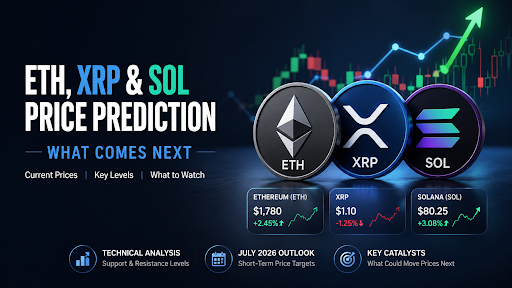
Say you put a hundred bucks into Ethereum, XRP, and Solana at the start of this year. You’d be checking the price a lot more than you planned to. That’s crypto in 2026 a slow bleed for months, then a sharp bounce, then everyone arguing about whether it means anything. This Ethereum, XRP and Solana price prediction explains the current position of all three coins, the reasons behind their movements and what the chart study professionals have in store for the future. No hype. No guaranteed numbers. Just the picture as it stands. Where ETH, XRP, and SOL Stand Today Ether currently trades around the upper $1,700 range, which it has maintained for more than a week since its bounce off a tough spring. XRP trades around $1.10 and struggles to reclaim some territory it lost in an awful June where it lost more than 20% within the month. Solana experienced the most volatile performance among the three by falling into the upper $60s in June but then rallying to $80. None of these coins are anywhere near their 2025 highs. ETH peaked near $5,000 last August. XRP touched $3.65. Solana has traded above $200 before. The gap between those highs and today’s prices is exactly why so many people are searching for a price prediction right now — they want to know if the bounce is real or just noise. Ethereum Price Prediction: Can ETH Hold the Line? Ethereum’s story right now is really two stories fighting each other. On one hand, big holders keep buying. Firms like Bitmine have kept adding to their ETH stacks, and a new group called Ethereum Institutional launched this month just to help large investors get comfortable holding it. On the other hand, daily active users on the network have dropped to new lows, even as whale wallets keep growing. If it can’t, a slide back toward $1,670 is on the table. Long-term, some banks have floated numbers as extreme as $40,000 within the decade, while more cautious estimates land closer to $10,000.That’s a huge span, and it’s a reflection of the uncertainty of the long-term outlook. It’s not the cost that you need to be concerned with. It’s whether Ethereum’s Glamsterdam upgrade, which will increase the amount of transactions the network can process per block, is going to ship on schedule later this year. Upgrades like that tend to matter more than any single week of price action. XRP Price Prediction: Waiting on the $1 Line XRP came into July right on the edge of $1, its weakest spot since late 2024. What’s strange is that nothing bad actually happened to Ripple, the company behind it. June was a fairly normal month for XRP news.That’s close to $1.5 billion in fresh institutional money, even while the price was falling—which usually means big players are betting on a longer-term recovery rather than reacting to this week’s headlines. The number everyone’s watching is $1.20. Reclaim that, and XRP breaks a downtrend that’s lasted a full year. Fail, and $0.80 to $0.93 becomes the next stop. A lot also hinges on the CLARITY Act, a bill working through the Senate that would settle XRP’s legal status as a commodity once and for all. It missed its original July 4 target and now looks likely to slip into late July or August, which means traders may be watching Congress almost as closely as they watch the charts. Solana Price Prediction: Fundamentals vs. Price Action Solana is the odd one out here, because its network numbers look genuinely strong while its price still lags. Active wallet addresses are pushing toward 7 million, close to a yearly high. Transactions per second are climbing toward 1,100, near an all-time record for the network. Yet SOL is sitting close to its lowest price in over a year. That gap between “the network is busy” and “the price is down” is the whole Solana story right now. Most July models put SOL’s range between $75 and $100, with a break above $90 seen as the trigger for a run toward $120. A firmer floor sits near $70 to $73; lose that, and the mid-$60s come back into play. In the longer term, the spread between forecasters gets almost comically wide—Standard Chartered’s base case points to $250 by year-end, while more aggressive traders have floated $400 to $1,000 over the next couple of years. Take any single number in that range with a grain of salt. Solana’s Alpenglow upgrade, expected to activate later this year, is the fundamental story to track. It’s meant to speed up how fast the network finalizes transactions, and it’s the kind of thing that tends to matter to Solana’s price more than a week of Twitter sentiment. What Could Push All Three Higher A few things show up again and again across ETH, XRP, and SOL forecasts. Continued ETF inflows are one money keeps entering crypto funds even during price dips, which analysts read as a sign of longer-term confidence. Clearer U.S. crypto regulation is another, especially anything that resolves how XRP and similar tokens get classified. And a friendlier Federal Reserve, meaning fewer worries about interest rate hikes, tends to lift the whole market at once, since lower rates make holding non-yielding assets like crypto less costly. What Could Send Them Lower The flip side matters just as much. All three coins fell together in June, which is a reminder that broad market sell-offs don’t care about any one coin’s fundamentals. A stalled CLARITY Act, weaker-than-expected ETF demand, or a delay to either Ethereum’s or Solana’s upcoming network upgrades could each knock momentum out of a recovery that’s still fairly fresh. For more background on how U.S. regulators currently treat digital assets, the Securities and Exchange Commission’s crypto assets page is a useful starting point. So, Where Does That Leave You? If you’re tracking this space closely, our team at USA Crypto Trends updates our ethereum xrp solana price prediction coverage as new data comes

Ethereum Price Prediction 2030: What the Numbers Actually Show
In late 2021, I decided to invest in a little bit of Ethereum which went up to nearly $4,900 before going down to below $2,000 for most of 2026 as I struggled to understand why I made that decision. If you are in a similar situation, you have probably been typing “ethereum price prediction 2030” into Google search at least once or twice at midnight hoping someone would tell you how to solve your problem. Well, I can’t but I can certainly show you some insights about what the forecasts say, their contradictions, and why. Where Ethereum Stands Right Now Late July 2026, ETH is sitting around $1,880 to $1,920. Market cap near $233 billion. Still the second biggest crypto behind Bitcoin, not even close to its all-time high of roughly $5,000 from August 2025. A lot of that drop is just 2026 being a rough year. Recession fears spooked the market early on, and Vitalik Buterin selling a big chunk of his own ETH didn’t help sentiment either. Founders selling always rattles people, even when it’s just personal financial planning on his end. None of that tells you where the price is going. It just explains why you’re reading this at 11pm. Ethereum Price Prediction 2030: The Realistic Range Here’s where it gets interesting. Ignore the outlier numbers you see on crypto Twitter and most serious ethereum price prediction 2030 estimates land between $8,000 and $12,000. That’s coming from analysts who actually look at usage data: how many transactions the network is processing, how much developer activity there is, that kind of thing. Coinbase’s own prediction tool is way more boring. Plug in a flat 5% annual growth rate and you get about $2,800 by 2030, which is barely above where ETH sits today. I don’t love that model, but it’s a useful reminder that “price prediction” often just means “whatever growth rate you feel like typing in.” On the positive side, Standard Chartered believes that ETH has a chance of surpassing Bitcoin, with price expectations of about $40,000 in the long term. In contrast, VanEck came to a different conclusion, using a cash flow valuation model with transaction fees and profits from the network. VanEck arrived at a price of about $11,800. However, these figures are not simply numbers guessed out of thin air. They are based on the calculations from existing models. However, the model is only as good as its assumptions and, as history shows, many assumptions can become obsolete in the cryptocurrency world. If there were one number you should use when making predictions, it would be $8,000-$12,000 in 2030. Rather than $25,000 from the headlines. Instead, we are presented with moderate estimates that are limited to the values of the price of cryptocurrency given from independent analyses. Will Ethereum Hit $10,000? Ten thousand has turned into this weird psychological finish line for ETH. Getting there isn’t crazy, but it needs a couple of specific things to go right. First: the Glamsterdam upgrade, expected mid-2026, has to actually work at pushing more fee revenue back to the base layer. Ethereum just had its busiest quarter ever, over 200 million transactions in early 2026, and the price still dropped 32% during that same stretch. That gap between “network is being used a ton” and “price is falling anyway” is the whole problem Glamsterdam is supposed to solve. Second: stablecoins. Standard Chartered and the U.S. Treasury have both floated numbers in the $2 to $3 trillion range for stablecoin market size in the coming years, and most of that runs on Ethereum rails. More stablecoin activity means more baseline demand for the network itself, not just speculative trading. Both things go right, $10,000 is realistic. Either one falls flat, and you’re probably looking at $3,000 to $4,000 territory instead. Eth Price Prediction 2040: Looking Further Out Push the timeline to 2040 and honestly, take everything with a grain of salt. Nobody knows what the internet looks like in fifteen years, let alone crypto specifically. The algorithmic models that use historical volatility to extrapolate forward have put ETH somewhere around $100,000 to $135,000 by then. I wouldn’t plan a retirement around that number. What matters more is the direction those models are pointing: continued growth in decentralized finance, tokenized assets, and blockchain infrastructure generally. If that trend keeps going, Ethereum’s value likely keeps climbing too. Just not in a straight line, and probably not on any schedule you’d want to bet your rent money on. Is Ethereum a Good Investment in 2026? Depends entirely on how much stomach you have for volatility. ETH has posted year-over-year gains over 80% and losses over 60%, sometimes in the same twelve-month stretch. That’s just what this asset class does. If you’re still learning how digital assets work before putting money in, the SEC’s investor education site covers the basics of risk and how crypto is regulated in the U.S. Worth a read before anything else. For anyone tracking ETH day to day against where the market thinks it’s headed, our full ethereum price prediction 2030 breakdown gets updated as new data comes in. Ethereum ETF Price Impact Spot Ethereum ETFs opened the door for institutional money that couldn’t touch crypto directly before. Every ETF share has to be backed by real ETH, so that creates steady buying pressure that just didn’t exist pre-2024. It’s not dramatic day to day. But it changes who’s holding the asset. Pension funds and asset managers don’t panic-sell the way retail traders do during a bad week, and that steady hand tends to support prices over the long haul instead of causing spikes. Eth Staking Rewards And Long-Term Value After switching to the proof-of-stake system, ETH holders can stake their ETH and receive rewards in return for helping the network to operate. The staking yield fluctuates but is always relatively low at around a few percent annually, which is not enough to get rich. What people often overlook when it comes to staking is that

Bitcoin Price Prediction 2026: What Could Happen Next?
We don’t know, but if you bought Bitcoin close to the top last October then it’s been a rough 2026. This is pretty much all of the crowd doing “Bitcoin price prediction 2026” on Google right now. Don’t people after a piece of trivia, people trying to understand whether it is the end of the worst. Bitcoin’s first half of 2026 wasn’t great. We cannot give you a magic number here, since nobody really does have one! We can just go through what real analysts are saying, what is happening in the market at this moment and what would have to change for things to go either way? This is provided for information purposes only and is not financial advice. Please consult a licensed advisor prior to making an investment. Where Bitcoin Stands Right Now in 2026 The cryptocurrency touched a record high above $120,000 way back in October 2025. It has been down since then. By early June 2026, its value had fallen by over 45%, with it currently priced at somewhere above $50,000 or below $60,000. This is arguably one of the worst periods for bitcoin since 2022. There were several factors contributing to it. Investors witnessed massive withdrawals from spot bitcoin ETFs in the months of May and June. While there was no rate cut from the Federal Reserve as expected, investors sought safer investments. Tensions between the U.S. and China did not help matters. Finally, when Strategy, the company founded by Michael Saylor, divested some of its bitcoin to pay for a dividend, it frightened many more than the actual sum of money should have. None of that means the story is over. It just means the bitcoin price prediction 2026 conversation has turned a lot more cautious than it was a year ago. The Big Bitcoin Price Predictions for 2026 Wall Street is genuinely split on this one, and the gap between the low and high targets is enormous. Geoff Kendrick of Standard Chartered has revised his 2026 goal twice. He initially had it at $300,000, then reduced it to $150,000 and has now reduced it further to $100,000 by the end of this year. Still a long way to go from its current level but the trend of such revisions speaks volumes about the bulls. Bernstein hasn’t budged. The firm is still calling for $150,000 this year. Their reasoning is that this correction has run about three quarters so far, which is actually shorter than past bitcoin crashes that dragged on for a year or more, and they’ve pointed to corporate bitcoin treasuries continuing to buy even while ETFs were dumping. Then there’s the long-term crowd, who mostly aren’t talking about 2026 at all. Cathie Wood at ARK Invest hasn’t touched her $1.25 million target for 2030 she thinks bitcoin is quietly bottoming right now, charts or no charts. Michael Saylor, whose own company’s small sell-off helped spark part of this year’s panic, still talks about bitcoin eventually hitting $21 million a coin. No timeline on that one. He just believes it’s where things are headed, decades out. Prediction markets tell a blunter story than any of the analyst notes. Kalshi traders were putting close to 80% odds on Bitcoin falling below $60,000 again in 2026 and only about 27% on it ever cracking six figures this year. Even lower was the odds percentage of Polymarket which was only 12% with a new all-time high this year. If things remain ugly, that’s about $50,000 to $60,000; if the market just cuts sideways, it’s $65,000 to $85,000; if sentiment turns around quickly, it’s $100,000 to $150,000.. What Could Push Bitcoin Higher A Fed rate cut would probably help the most. Money tends to flow back into riskier assets like crypto once borrowing gets cheaper again. ETF flows matter just as much, maybe more—if the outflows that hammered bitcoin in May and June slow down or reverse, that alone could put a floor under the price, since fund flows have driven most of this year’s swings either way. Corporate buyers are the quiet part of this story. Bernstein pointed to roughly $10 billion flowing into corporate treasuries and ETFs combined this year, even during the worst of the selloff. That kind of demand doesn’t make headlines, but it adds up over months. There’s also the 2028 halving sitting out there on the calendar. Every time bitcoin’s new supply gets cut in half, it’s historically set up a rally a year or two later. Not a guarantee. Just a pattern that’s shown up enough times that people keep watching for it. What Could Push Bitcoin Lower More ETF outflows would hurt, badly. If big holders keep selling the way Strategy did earlier this year, it tends to spook smaller investors into selling too, and that’s how a modest sell-off turns into a real slide. Trade tension is the other wildcard—when tariffs and export controls hit the news earlier this year, Bitcoin dropped right alongside stocks, despite all the “digital gold” talk. Sentiment alone can do a lot of damage too. The Fear and Greed Index sat in “Extreme Fear” for stretches of this year, and when regular traders get scared, they tend to sell first and think about it later. Should You Trust Any Bitcoin Price Prediction for 2026? Depends on what’s behind the number. A forecast tied to ETF flow data, the halving cycle, or Fed policy at least gives you something to reason about, even if the price ends up wrong. A forecast that’s just a big round figure with no explanation attached is basically a guess wearing a suit. If you’re weighing a real decision with your own money, don’t anchor to one analyst. Look at the spread instead. Right now that’s roughly the high $50,000s on the bearish end to well over $100,000 on the bullish end, and where you land probably says more about which assumptions you believe than anything else. Bitcoin’s spent over a decade making both the bulls